The Early Years
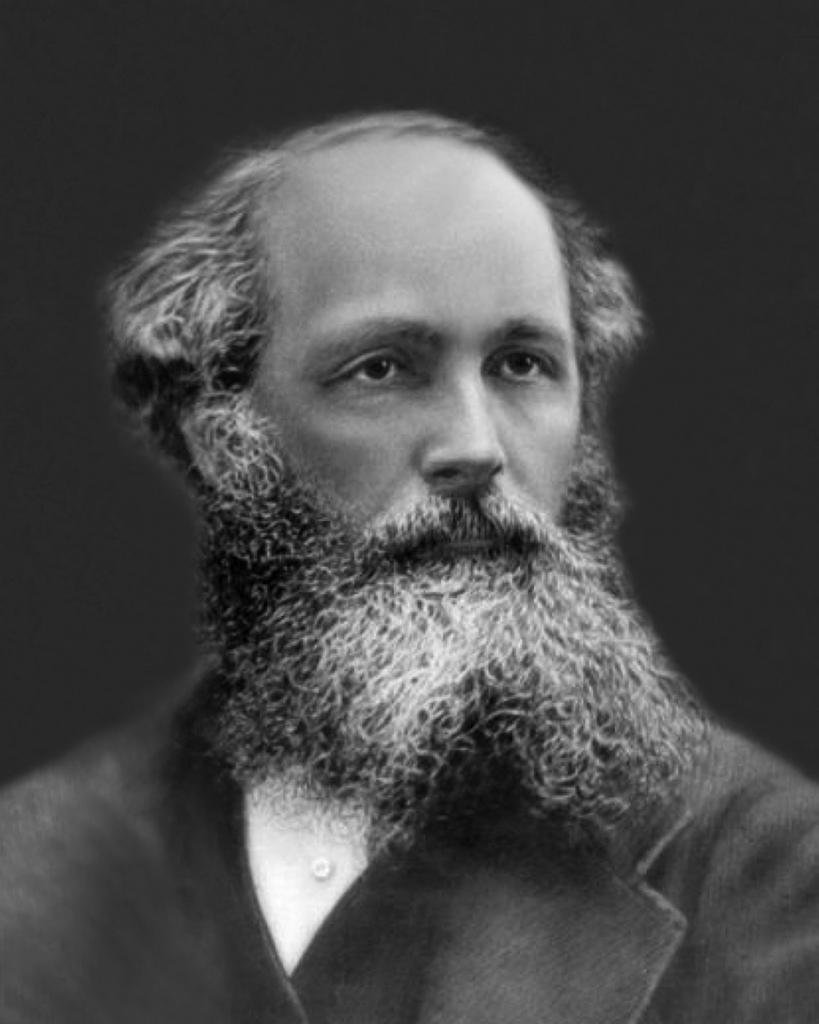
On June 13th, 1831 - John Maxwell and Frances Cay gave birth to a baby boy on 14 India St, Edinburgh, Scotland. Little did they know, they just gave birth to a future scientist who would go on to have an impact on the world amongst the ranks of Albert Einstein and Isaac Newton.
James wrote his first scientific paper in 1846, at the age of 14. This paper explored the extension of the common theory of the foci of the conic sections to curves of a higher degree of complication.
University
At the age of 16, Maxwell began attending classes at the University of Edinburgh. During his courses, Maxwell found extra time for private study as he found the course material to not be challenging. While at the University of Edinburgh, he had some highly regarded tutors: Sir William Hamilton, Philip Kelland, and James Forbes.
At the age of 18, Maxwell submitted two papers to the Royal Society of England. These papers were titled "On the Equilibrium of Elastic Solids" and "Rolling Curves". One year later, Maxwell left University of Edinburgh and began attending the University of Cambridge in England. Transferring from Peterhouse to Trinity, where he was elected into the elite Cambridge Apostles - Maxwell explored his faith and science during this time.
Maxwell graduated with a degree in mathematics from Trinity in 1854, scoring second-highest on the final test and earning the title "Second Wrangler".
Post-University
After graduating university, Maxwell would become a fellow at Trinity until 1856. He took a professorship at Marischal College, Aberdeen in Scotland at the age of 25.
In the late 1850s shortly before 9 am any winter’s morning you might well have seen the young James Clerk Maxwell, in his mid to late 20s, a man of middling height, with frame strongly knit, and a certain spring and elasticity in his gait; dressed for comfortable ease rather than elegance; a face expressive at once of sagacity and good humour, but overlaid with a deep shade of thoughtfulness; features boldly put pleasingly marked; eyes dark and glowing; hair and beard perfectly black, and forming a strong contrast to the pallor of his complexion.
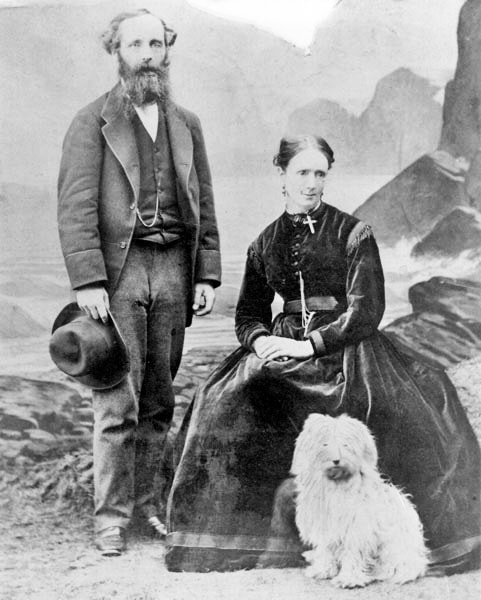
On June 2nd, 1858 Maxwell married Katherine Mary Dewar. Katherine was 7 years older than Maxwell, and not much has been recorded about her. During this time it is listed that Maxwell was the professor of Natural Philosophy at Marischal College.
In 1860, Marischal College merged with King's College. Maxwell's position was deemed redundant, and he was laid off (29 years old).
Greatest Work
After surviving a near-death bout of smallpox, Maxwell took up a position at King's College in London as the Chair of Natural Philosophy in 1860. During this time, Maxwell's work is seen as most productive.
In 1861 he published "On Physical Lines of Force", which would discover and define the laws of electromagnetism. Using previous work from Wilhelm Eduard Weber and Rudolf Kohlrausch in 1856, he established a connection between the speed of light and the speed of propagation of waves in a sea of molecular vortices.
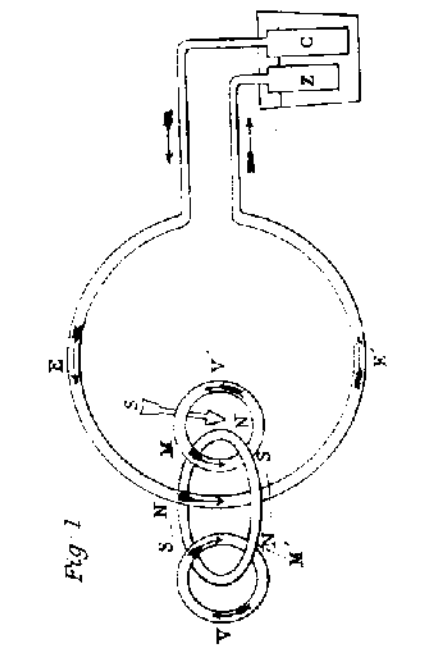
This paper would also catalyze progress in the mathematical field of vector calculus. It is widely considered one of the most historically significant publications in physics and science in general.
Brush Up on Maxwell's Equations

Gauss's Law for Electricity:
Gauss's Law for Magnetism:
Faraday's Law of Induction:
Ampère's Circuital Law (with Maxwell's correction):
These equations unified electricity and magnetism into a single theory of electromagnetism, showing that light itself is an electromagnetic wave.
Legacy
Very few individuals have had as big of an impact on society as Maxwell did. His work helped lead to the development of radio, television, and mobile phones by unifying various fields in physics to unveil electromagnetism.